Nestle-Lemur
Sources and Documents
Permanent Wave and Nestlé–LeMur
Sources and Documents
This section brings together primary sources related to the Nestlé–LeMur Company and the industrial development of the permanent wave.
The material presented here includes contemporary newspaper reports, advertisements, trade publications and archival documents. These sources provide direct insight into the formation of corporate structures, the expansion of manufacturing and the commercialisation of permanent waving technology.
Particular attention is given to documents from the late 1920s, including reports on the merger between C. Nestle & Co., New York, and the Le Mur Company of Cleveland. These records help to reconstruct the transition from individual enterprise to organised industrial production.
All documents are presented as part of an ongoing research process. Where possible, sources are cited in their original form and contextualised within the broader historical development of the permanent wave industry.
This section is continuously expanded as new material becomes available through archival research.
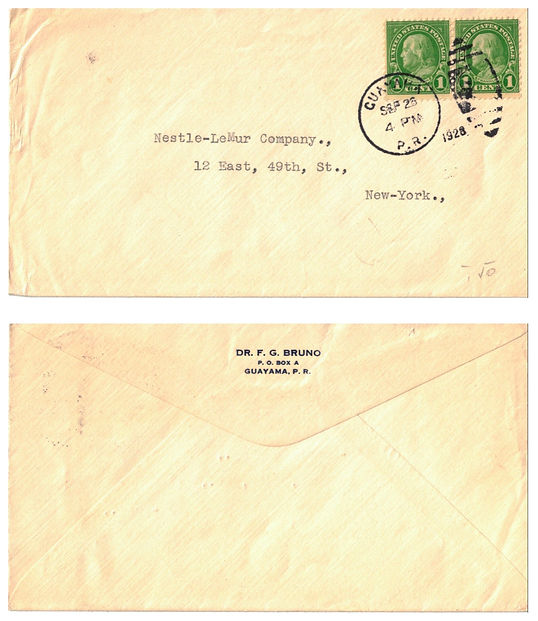
Envelope addressed to the Nestlé–LeMur Company, 12 East 49th Street, New York, postmarked September 1928 in Guayama, Puerto Rico. The document provides evidence of business correspondence and indicates the company’s operational reach shortly after its formation.
From Correspondence to System
The expansion of the permanent wave industry can also be traced through seemingly minor archival material such as postal correspondence.
An envelope addressed to the Nestlé–LeMur Company at 12 East 49th Street, New York, and postmarked in September 1928 in Guayama, Puerto Rico, provides concrete evidence of the company’s operational reach shortly after its formation.
Unlike promotional material or technical documentation, this type of source reflects everyday business activity. It indicates that the company was already engaged in communication beyond the continental United States and suggests the existence of established distribution or customer networks in overseas territories.
The geographic origin of the correspondence is particularly significant. Puerto Rico, as a United States territory, formed part of a wider economic framework in which goods, services and technical systems could circulate more freely. The presence of such correspondence implies that permanent waving technology, or related products and equipment, had begun to move within these extended networks.
This material illustrates an important aspect of industrial development that is often overlooked. The success of the permanent wave was not determined by invention alone, but by the ability to distribute, communicate and maintain a functioning commercial network.
In this context, the Nestlé–LeMur Company represents not only a continuation of earlier technical innovation, but also the consolidation of a system capable of operating across regional and transnational boundaries.

Advertisement for the “Nestle Permanent Wave,” published in Ladies’ Home Journal, April 1930. The image promotes the concept of an “individualized coiffure” and illustrates how a standardised permanent wave system was presented as a personalised beauty service.
Source: Ladies’ Home Journal, April 1930, p. 144.
Product Presentation and Consumer Positioning
The industrialisation of the permanent wave required not only technical standardisation, but also a redefinition of how the process was communicated to consumers. Advertising material from this period reveals how a highly structured and apparatus-based system was translated into a language of individuality and personal style.
An advertisement published in Ladies’ Home Journal in April 1930 illustrates this shift with particular clarity. While the underlying technology depended on controlled procedures and standardised equipment, the text foregrounds the concept of the “individualized coiffure.” The emphasis on individual hair analysis and tailored treatment serves to reframe a uniform technical process as a personalised service.
This tension between standardisation and individualisation is central to the industrial development of cosmetic technologies. The reliability of the system made large-scale application possible, yet its acceptance depended on presenting it as adaptable to personal needs and aesthetic preferences.
The visual composition reinforces this positioning. The depiction of a carefully styled woman, combined with references to comfort and elegance, situates the permanent wave within a broader cultural framework of modern femininity. The process is no longer defined in technical terms, but integrated into a narrative of self-presentation and controlled appearance.
In this context, the advertisement marks a decisive moment. It demonstrates how an industrial technology was not only produced and distributed, but also conceptually reframed in order to align with consumer expectations. The permanent wave thus emerges not merely as a technical innovation, but as part of a broader transformation in the relationship between industry, marketing and everyday life.

From Apparatus to Product
The industrialisation of the permanent wave did not end with the development of complex machinery. It extended further into the standardisation and commercial presentation of complete systems.
An advertisement for the “Nestle Fleetwave” permanent waving machine illustrates this transition. Presented as a finished product with a fixed price and a clearly defined function, the machine reflects a shift from technical apparatus to market-ready equipment.
Unlike earlier experimental devices, the Fleetwave is no longer described in terms of process or invention. Instead, it is positioned as a reliable and modern solution, emphasising ease of use and availability. The slogan “The Permanent of Tomorrow… Today” highlights this forward-looking positioning and reinforces the idea of technological progress made accessible to a wider market.
The reference to public demonstrations further indicates how the technology was integrated into commercial distribution strategies. Permanent waving was no longer confined to individual expertise or specialised salons. It became part of a system that combined production, marketing and direct presentation.
In this context, the machine represents more than a technical development. It marks the point at which the permanent wave was fully embedded within an industrial and commercial framework.
Advertisement for the “Nestle Fleetwave” permanent waving machine, marketed by the Nestlé–LeMur Company. The image illustrates the transition from technical apparatus to standardised commercial product.