Nestle-Lemur
The Nestle-LeMur Company
Origins and Industrial Development
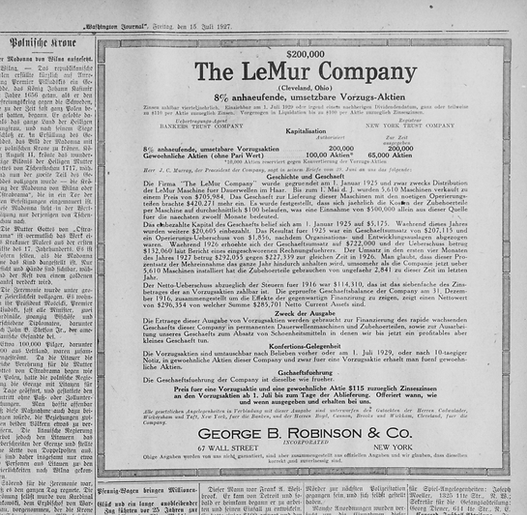
LeMur Company 1927 newspaper advertisement Cleveland Ohio describing permanent wave machines business structure and stock capitalisation
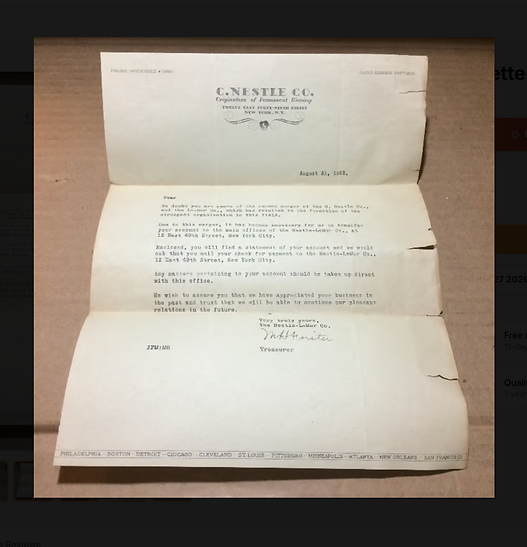
Nestle-LeMur Company letter, September 8, 1928 (New York / Cleveland). The document explicitly refers to a “present combination between the Nestle Co. and LeMur Company.”
Source: Digital image of a historical document offered via a non-verifiable online marketplace; preserved through screenshot documentation.
The designation “Nestle-LeMur Company” does not appear in historical sources as an original foundation, but rather as the result of a development within the early permanent wave industry.
While the invention of the permanent wave is closely associated with Karl Ludwig Nessler, the large-scale industrial implementation of this technology was shaped by multiple companies. Among them, the LeMur Company and the Nestle Company played a central role.
The following documents allow a reconstruction of this transition—from independent operations to a combined industrial organization.
The LeMur Company – Origin of an Industrial System
Image caption:
The LeMur Company (Cleveland, Ohio), newspaper publication, 1927. The document describes the company’s structure, business model, and large-scale distribution of permanent wave machines.
A contemporary document published in 1927 provides direct insight into the early structure of the LeMur Company.
The company is described as an independent enterprise based in Cleveland, Ohio, founded on January 1, 1925. Its purpose was the distribution of machines for permanent waving.
The scale of operations is particularly notable. By mid-1927, several thousand machines had already been sold and installed. In addition to the machines themselves, a significant portion of revenue was generated through accessories and consumable components required for continued use.
This document demonstrates that the LeMur Company was not an experimental venture, but an established industrial system. It represents the transition of permanent wave technology from an individual invention into a scalable commercial infrastructure.
The Nestle Company – Name and Continuity
At the same time, the name “Nestle” remained active in the market.
Advertisements from the period document products associated with permanent waving, including preparations and treatments linked to earlier developments. The continued use of the name indicates a connection to the original innovation and its commercial identity.
The Nestle Company can therefore be associated with the origin, branding, and early market presence of permanent wave technology.
The Formation of the Nestle-LeMur Company
Image caption:
Nestle-LeMur Company letter, September 8, 1928 (New York / Cleveland). The document explicitly refers to a “present combination between the Nestle Co. and LeMur Company.”
A company letter dated September 8, 1928 provides direct evidence for the formation of the Nestle-LeMur Company.
The document explicitly refers to a “present combination between the Nestle Co. and LeMur Company” and describes the resulting organization as the Nestle-LeMur Company.
This formulation is of central importance. It indicates that both entities—the Nestle Company and the LeMur Company—previously existed as separate organizations and were subsequently combined into a single structure.
The document therefore represents a key primary source for understanding the transition from independent operations to a unified industrial organization.
Integration and Industrial Development
The combination of the Nestle Company and the LeMur Company suggests a strategic integration of different elements:
-
industrial production and distribution systems (LeMur)
-
established name and prior development (Nestle)
The resulting organization appears to have unified these aspects within a broader industrial framework, supporting the expansion of permanent wave technology across professional markets.
Later references describe the Nestle-LeMur Company as a manufacturer of permanent wave machines and a supplier of beauty salon equipment, indicating continued industrial activity beyond the initial merger phase.
Sources and Open Questions
Despite the available documentation, several aspects remain unresolved:
-
the exact legal structure of the combination
-
ownership and financial arrangements
-
the role of individual actors involved in the transition
-
the precise timeline of integration
The existing sources nevertheless allow a clear conclusion: the Nestle-LeMur Company emerged from the combination of two previously independent firms and represents a decisive stage in the industrialization of the permanent wave.
Related Topics
Related Research
→ Permanent Wave – Development and Technology
→ Karl Ludwig Nessler – Biography (German)
→ Early Permanent Wave Systems (German)
→ Industrial System and Distribution Networks
→ From Apparatus to Industrial System
→ Nestlé–LeMur Company and Corporate Expansion
→ Primary Sources on the Permanent Wave Industry
FAQ
What was the Nestle-LeMur Company?
The Nestle-LeMur Company appears to have emerged from the combination of two previously independent firms involved in the permanent wave industry: the Nestle Company and the LeMur Company. A surviving company letter from September 8, 1928 explicitly refers to a “present combination between the Nestle Co. and LeMur Company.”
Was the Nestle-LeMur Company founded as a completely new company?
Available historical sources do not describe the Nestle-LeMur Company as an entirely new foundation. Instead, the documentation suggests that it resulted from the integration of previously existing companies active within the permanent wave industry.
What was the LeMur Company?
The LeMur Company was an industrial enterprise based in Cleveland, Ohio. Contemporary documents published in 1927 describe the company as a distributor of permanent wave machines and salon equipment operating on a large commercial scale.
Why is the LeMur Company historically important?
The LeMur Company represents an important stage in the industrialisation of permanent wave technology. Historical documents indicate that thousands of machines had already been distributed by 1927, demonstrating the transition from experimental invention to scalable industrial infrastructure.
What role did the Nestle Company play?
The Nestle Company appears to have maintained continuity with earlier permanent wave developments associated with the Nessler tradition. Advertisements from the period document products and treatments linked to the Nestle name within the permanent wave market.
What does the 1928 Nestle-LeMur letter demonstrate?
A company letter dated September 8, 1928 explicitly refers to a “present combination between the Nestle Co. and LeMur Company.” The document therefore represents an important primary source for understanding the formation of the Nestle-LeMur Company.
Why was the combination of Nestle and LeMur significant?
The combination appears to have united:
-
industrial production and distribution systems
-
established branding and market identity
-
permanent wave technology
-
salon infrastructure
This integration helped transform permanent waving from an individual invention into a broader industrial and commercial system.
Was the Nestle-LeMur Company only connected to permanent wave machines?
No. Later references describe the Nestle-LeMur Company not only as a manufacturer of permanent wave machines, but also as a supplier of salon equipment and related beauty industry products.
Are there still unresolved questions about the company?
Yes. Several aspects remain unclear, including:
-
legal structure
-
ownership arrangements
-
financial organisation
-
individual actors involved
-
the precise timeline of integration
The surviving documentation nevertheless clearly indicates that the company emerged from the combination of two previously independent firms.
Why is the Nestle-LeMur Company historically relevant?
The Nestle-LeMur Company represents a decisive stage in the industrialisation of the permanent wave. It illustrates how a technical invention associated with Karl Ludwig Nessler evolved into a structured industrial system operating across professional beauty markets
Timeline
1925
Foundation of the LeMur Company in Cleveland, Ohio.
1927
Large-scale distribution of permanent wave machines documented.
September 8, 1928
Company letter refers to the “present combination between the Nestle Co. and LeMur Company.”
Late 1920s–1930s
Expansion of industrial salon systems and distribution networks.
Later Years
Nestlé–LeMur develops into a broader beauty and industrial organisation.
Sources
-
Nestle-LeMur Company letter, September 8, 1928
-
Newspaper publication on the LeMur Company (1927)
-
Historical permanent wave advertisements
-
Trade publications related to salon equipment and beauty technology
-
Research material on the industrialisation of permanent waving
-
Archival documents connected to the Nestle and LeMur companies
The formation of the Nestle-LeMur Company represents more than a simple corporate merger. It reflects the broader transformation of permanent waving from an individual technical invention into an organised industrial and commercial system operating across professional beauty markets. The surviving documents demonstrate how innovation, branding, distribution and industrial infrastructure became increasingly interconnected during the expansion of the twentieth-century beauty industry.